A blog launched on the 41st anniversary of the Society for the Protection of Unborn Children (SPUC), the first pro-life organisation in the world, established on 11 January 1967. I wrote this blog in my role as SPUC's chief executive, commenting on pro-life news, reflecting on pro-life issues and promoting SPUC's work. I retired from my post on 31st August 2021 and will therefore be adding no further posts.
Fr Connolly (pictured), the parish priest of St. Kentigern's, Fallowfield, in Manchester, has posted a powerful homily on his website which he intends to deliver at Sunday Masses this weekend.
He says that the crowd in Nazareth hated Christ and: " ... they rose up in a foul rage and bundled him out and tried to throw him down a cliff. In other words - they hated him - our Saviour."
Referring, amongst other matters, to the Government's intention of making abortion and birth control drugs and devices even more accessible to schoolchildren through all state schools, including Catholic schools, he says:
"His Church is being treated like that now by those who hate us ...
" ... It is like saying to the MPs that the National Front should be allowed membership of their party. Religious faith is of no consequence. Our children will be forcibly indoctrinated by the false ideology of those who rule us. They say it will bring down teenage pregnancies. We have the highest in Europe seemingly. The reality is that 30 years of this kind of stuff in our High schools has not proven successful."
Too true Father.
And sadly, as I have mentioned frequently before, the Catholic Education Service in England and Wales (CESEW) has betrayed Catholics and non-Catholics alike by its giving general support to the British government’s legislative proposals to require all state schools to teach sex and relationships education throughout the school years (from ages five to 18). (N.B. The state schooling system in England and Wales includes the majority of Catholic schools.) The British government has stated clearly that its proposals have been drafted to entrench a form of sex education which promotes access to abortion and contraception in all state schools, including in Catholic schools.
In an article in this weekend's Catholic Herald, Eric Hester challenges the Catholic Education Service to a public debate "to obtain from any Government Minister a statement that it is true that school governors can 'determine the content' of what is taught in sex education and can omit anything that they do not like."
Eric Hester was a headteacher of Catholic comprehensive and grammar schools for 24 years and has extensive experience of inspecting schools. He writes:
" ... I have been informed by one bishop that they were given assurances by the CES [Catholic Education Service] that governors would have complete control and that there would be no question of any teaching about civil partnerships or information given to pupils about how to obtain contraception and abortion without parental consent.
"It seems as if the bishops have relied entirely on the information of the CES and ignored other advice. They have been deceived ... "
Eric is right. I have frequently posted on the government's plans on sex education and on the Catholic Education Service's betrayal of Catholics and non-Catholics alike - which is why my wife and I will not be giving to the collection in Catholic churches tomorrow in their support. The government has, for example, accepted all the major recommendations of the 2007/2008 report by the Teenage Pregnancy Independent Advisory Group (TPIAG). The report's major recommendations include that:
"The Government's current review of SRE should ...
* ... [s]tate clearly that all schools including faith schools must teach all aspects of SRE within the context of relationships in an anti-discriminatory way; contraception, abortion and homosexuality are all legal in this country and therefore all children and young people should be able to learn the correct facts
* ... [m]ake explicit links to young people's advisory services and provision of contraception and sexual health services and demonstrate this by teaching young people how to access services".
Eric Hester's article continues:
" ... John Paul II put the rights of parents like this in his Charter of the Rights of the Family: 'Article 5 c. Parents have the right to ensure that their children are not compelled to attend classes which are not in agreement with their own moral and religious convictions. In particular, sex education is a basic right of parent and must always be carried out under their close supervision, whether at home or in educational centres chosen and controlled by them.'
"I publicly challenge the CES to obtain from any Government Minister a statement that it is true that school governors can "determine the content" of what is taught in sex education and can omit anything that they do not like. Everything the Government has said is to the contrary. Under the Freedom of Education Act I have obtained correspondence between the CES and the Government, where the CES asks for that very assurance and is not given it.
"So does the CES claim that it has been given private assurances that all will be well? That was exactly the argument used about gay adoptions, where the Government broke any promises given and which has resulted in the ending of Catholic adoption in England as we used to know it. I further challenge the CES to debate sex education with me, or a better speaker, on behalf of Catholic teaching at a public meeting."
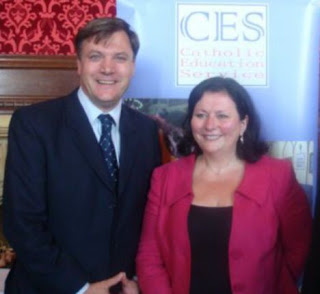
In many parts of England and Wales this weekend there will be a special collection for the Catholic Education Service (CESEW). (Pictured right are Ms Oonagh Stannard, the chief executive and director of the CESEW with Mr Ed Balls MP, Secretary of State for Children, Schools and Families.) My wife and I will not be giving a donation - and this is why:
The CESEW welcomes into Catholic schools Connexions, a British government agency. Connexions’ staff are trained* to tell children that they have a right of access to abortion and contraception without parental knowledge or consent. SPUC has evidence of Connexions’ staff giving children such information in Catholic schools. In addition, the Connexions website includes pages promoting abortion and contraception to children.
(2) CESEW is giving general support to the British government’s legislative proposals to require all state schools to teach sex and relationships education throughout the school years (from ages five to 18). (N.B. The state schooling system in England and Wales includes the majority of Catholic schools.) The British government has stated clearly that its proposals have been drafted to entrench a form of sex education which promotes access to abortion and contraception in all state schools, including in Catholic schools.
CESEW has defended itself on these matters. CESEW’s defence, however:
• fails to present Catholic teaching on sex education
• is at variance with Catholic teaching on sex education
• provides no credible evidence for its claim that, under the government's proposals, Catholic schools will be able to uphold Catholic teaching on sexual ethics
• leaves pupils in non-Catholic schools (which are attended by many Catholics) at the mercy of the full force of government-specified pro-abortion sex education
• endorses the presence of on-site sexual health clinics at schools, including in Catholic schools.
*Connexions, “Young people and sexual health – A Reader for those participating in the Connexions’ training programme”, Crown Copyright 2003.
I am delighted to see that RADAR, (chaired by Baroness Campbell of Surbiton [pictured]) has responded to the Gilderdale case on which I blogged yesterday. On Monday Kay Gilderdale was acquitted of attempted murder after admitting to assisting her 31 year old daughter’s suicide. Lynn was diagnosed with chronic fatigue disorder at 14 and said that she decided she wanted to die after being ill for many years. RADAR is a charity ran by disabled people and the UK’s largest disability campaigning network.
Their press release can be found on their website, but I reproduce here in full:
Amidst the clamour for the laws on assisted suicide to be changed following the case of Lynn Gilderdale, RADAR wishes to state its commitment to the principle that those who have a hand in the death of another person, regardless of that person’s disability or the stated motivation of the perpetrator, should have to answer for their actions before a court of law.
This provides a vital safeguard for thousands of the most vulnerable people in our country, and creating a group of people for whom this safeguard does not exist is both dangerous and discriminatory.
This danger is further illustrated by the case of Tom Inglis. His mother Frances, in spite of medical opinion and acting on her own convictions that he was suffering and that it was what he would have wanted, decided to kill her brain-damaged son.
What if it was not what he wanted, at that time? What right did Frances Inglis have to make that decision for him? Tom’s disability does not give another person, even his mother, the right to take his life based on their own judgements. Tom has the same rights to legal protection and justice as anyone else, and the prospect of setting out circumstances in which people whose lives are deemed by others to be intolerable can be stripped of those rights is chilling beyond measure.
Commenting in the wake of the Gilderdale judgement Caroline Ellis, RADAR’s Joint Deputy Chief Executive whose teenage son has Chronic Fatigue Syndrome (CFS), the same condition as Lynn Gilderdale, said:
“I condemn those who would try to use this case as ammunition for their fight to legalise assisted dying for people who are terminally ill or severely disabled or introduce a so-called ‘mercy killing’ defence. Singling out individuals for legalised killing based on their medical condition or prognosis would be discriminatory and repugnant – we must maintain current legal protections.”
“The real outrage is that people with CFS and their families are literally left to get on with it, with most not getting effective treatment or support. I am staggered at the lack of specialist resources available.”
“I have no way of knowing how severely CFS will affect my own child in the future but I know this: I never want him to feel like society is giving up on him, I want him and everyone else living with illness and impairment and their families to be supported to live [author’s emphasis], with access to the best possible care and support, free at the point of use. The idea that the law could be relaxed in future to encourage people to give up sends chills down my spine.”
According to the Daily Telegraph this morning, David Cameron (pictured), the leader of the Conservative party has said regarding sex education for schoolchildren:
“Should we teach them about civil partnerships being a way of same-sex couples showing commitment just as married couples show commitment? Yes we should.”
He apparently made it clear at a Cameron Direct meeting that this should be embedded "in the ethos of our education".
Last week I reported that Ed Balls, the Secretary of State for Children, Schools and Families, agrees with Nick Clegg, the leader of the Liberal Democrats, that faith schools must teach that homosexuality is normal and harmless.
It appears, then, that the three major party leaders are in step with each other on this issue. All of this, of course, is in the context of the Government's Children, Schools and Families bill currently being considered by the Public Bill Committee in Parliament. This bill would make sex education compulsory in all state schools, including faith schools, from ages 5-16.
The first consequence of this rare agreement between party leaders is that concerned citizens must ensure that they don't vote along party political lines, but reflect on the voting intentions and voting record of individual parliamentary candidates.
It's important to remember, as the general election approaches, that David Cameron is on record as backing wider access to abortion and that all three party leaders voted in support of the Human Fertilisation and Embryology Act, a law designed to kill countless human beings who are deliberately created never to be born.
The second consequence of the major party leaders' consensus on civil partnerships is that concerned citizens should make it clear that they refuse to allow their children to be taught in such a way at any stage in their education. As Catholics and pro-lifers, my wife and I have always taken this stand. We must never forget in this connection the teaching of Pope John Paul II in Evangelium Vitae, paragraph 97. He said that it is an illusion to think that we can build a true culture of human life if we do not offer adolescents and young adults an authentic education in sexuality, and in love, and the whole of life according to their true meaning and in their close interconnection.
We must begin to organize more effectively to resist, peacefully and firmly, the State's attacks on the moral welfare of our children. In addition, Catholic parents and young people must also resist, peacefully and firmly, Catholic episcopal policy in England and Wales (on the government's sex education plans), which is contrary to Catholic teaching, undermines the culture of life, and betrays our children and unborn children by delivering them to the abortionists.
This morning SPUC issued a statement expressing concern at the outcome of the case of Lynn Gilderdale whose mother was acquitted of helping to kill her. ( Lynn was diagnosed with chronic fatigue disorder at 14 and said that she decided she wanted to die after being ill for many years.)
I commented:
"The jury's verdict and the judge's comments appear to have disturbing implications for vulnerable, disabled and seriously ill people. Laws against assisted suicide are actually there to protect such vulnerable people. We shall be studying this sad and worrying case carefully with a view to doing all in our power to step up our educational and political campaign on the need to explain and maintain the current legislation in this area.”
Mrs Kay Gilderdale was acquitted of the charge of attempted murder after admitting to assisting her 31 year old daughter’s suicide “by giving her sleeping pills, antidepressants and injecting air into her veins … after her daughter [Lynn] had injected herself with morphine”.
The media treatment of this story has been dominated by anti-life propaganda. For example, The Daily Telegraph, in nearly three pages of coverage sympathetic to Kay Gilderdale – pages one, two and three – devoted 30 words to presenting a pro-life perspective.
Media hero of the day is High Court Judge, Mr Justice Bean, who criticised the prosecution for pursuing the charge of attempted murder and who paid tribute to the jury’s “common sense, decency and humanity” for acquitting Kay Gilderdale of attempted murder of her daughter.
This case highlights the pitfalls of “pseudo-compassion”, the theme of a timely article entitled “The Pitfalls of Compassion” published this week by Monsignor Michael Schooyans, Professor Emeritus at the University of Louvain.
Monsignor Schooyans explains that compassion has traditionally been understood as an expression of human solidarity in suffering. To be compassionate has been thought to show understanding, to sympathize or to comfort. However, “in cases of abortion, euthanasia and assisted suicide which appear in the news, compassion is frequently invoked to 'justify the act'". As killing somebody is not self-evidently compassionate, in the same way that comforting them is, compassionate intentions have to be presented as the justification for killing.
The Gilderdale case is an example of “compassion” being used as a justification for killing, rather than the expression of care towards another. Schooyans explains that coupled with judgments on the quality of life of human beings, this pseudo-compassion becomes the vehicle by which the most vulnerable in society are disposed of. Schooyans uses the example of an unborn child with disabilities to explain how people can be “ethically” exterminated. By claiming that the only way to help such children is by terminating their lives, society has created a moral principle whereby a child will be killed out of compassion. Likewise with Lynn Gilderdale the jury considered it justified for her mother to kill her on the “compassionate” grounds that it was the best way to relieve her daughter of her suffering.
Monsignor Schooyans explains that this brand of ethics goes on to impose its framework upon society. In the case of abortion it is claimed that it is contrary to compassion to impose the “insupportable ‘burden’” of pregnancy upon women. The act of abortion then is justified by its ‘compassion’ toward both mother and child and those who object to such an action thereby become opponents of “compassion”.
Schooyans explains, compassion has been further “manipulated” as a tool of congratulation. This is seen in the demand by society to sympathise with and applaud those doctors who
“‘for the good’ of the child or its mother take the ‘courageous’ decision to go ahead with an abortion”.
Such congratulation for what Schooyans dubs as “bogus compassion” has terrifying consequences. Schooyans cites the 1962 case in Belgium where a woman who murdered her child who had been born with “serious malformations” due to her having taken thalidomide, was acquitted by the Belgian court to “hearty applause from the public.”
The same “bogus compassion” is at operation and imposes its framework in the Gilderdale case. A false understanding of the notion of compassion has led a mother to kill her daughter, believing that it was the compassionate thing to do. This "compassion" has been manipulated by the judge as a tool of congratulation in his remarks to the jury - with the clear implication that those who might oppose the jury's decision are the opponents of compassion.
We must stand firm for true compassion. Last week Margo MacDonald launched her End of Life Assistance (Scotland) Bill in the Scottish Parliament. Alison Davis of No Less Human, a division of SPUC, who lives with severe spina bifida and other debilitating conditions that have brought her to the brink of suicide in the past, told the Scottish media:
"Sometimes what desperate people, disabled or not, need is to be given hope. What they definitely don't need is to be told they are right to feel so unhappy and that they would be better off dead. This is simply the moral equivalent of the practical example of seeing a person about to jump off a high bridge and giving them a push."
I hope the interview with Ed Balls (pictured), the Secretary of State for Children, Schools and Families, in yesterday's Telegraph, will persuade Catholic church leaders in England and Wales that they are wrong about British government policy on sex and relationships education policy.
The Telegraph interview says:
" ... Does he agree with Nick Clegg that faith schools should be forced to teach that homosexuality is normal and harmless? The answer is yes. 'If their faith has a view in scripture, they can inform pupils of that. What they must not do is teach discrimination. They must be absolutely clear about the importance of civil partnerships [and that] bullying of homosexuals is wrong ... '".
Now Archbishop Nichols reportedly says that British government policy means that Catholic schools have "retained their rights through the governing body that their sex and relationships education is delivered according to Catholic ethos and teaching".
So does that mean, in the light of Ed Balls's reported statement above, that Catholic schools can teach paragraphs 2357 - 2359 of Catechism the Catholic Church? These state:
2357 Homosexuality refers to relations between men or between women who experience an exclusive or predominant sexual attraction toward persons of the same sex. It has taken a great variety of forms through the centuries and in different cultures. Its psychological genesis remains largely unexplained. Basing itself on Sacred Scripture, which presents homosexual acts as acts of grave depravity,140 tradition has always declared that "homosexual acts are intrinsically disordered."141 They are contrary to the natural law. They close the sexual act to the gift of life. They do not proceed from a genuine affective and sexual complementarity. Under no circumstances can they be approved.
2358 The number of men and women who have deep-seated homosexual tendencies is not negligible. This inclination, which is objectively disordered, constitutes for most of them a trial. They must be accepted with respect, compassion, and sensitivity. Every sign of unjust discrimination in their regard should be avoided. These persons are called to fulfill God's will in their lives and, if they are Christians, to unite to the sacrifice of the Lord's Cross the difficulties they may encounter from their condition.
2359 Homosexual persons are called to chastity. By the virtues of self-mastery that teach them inner freedom, at times by the support of disinterested friendship, by prayer and sacramental grace, they can and should gradually and resolutely approach Christian perfection.
And when teaching children about "the importance of civil partnerships", is it the British Government's policy that Catholic church schools can do so in accordance with Catholic teaching on the subject which has been so well explained by Fr Boyle in his blog, Caritas in Veritate?
"The Government's current review of SRE should ...
... [s]tate clearly that all schools including faith schools must teach all aspects of SRE within the context of relationships in an anti-discriminatory way; contraception, abortion and homosexuality are all legal in this country and therefore all children and young people should be able to learn the correct facts
... [m]ake explicit links to young people's advisory services and provision of contraception and sexual health services and demonstrate this by teaching young people how to access services"
"TPIAG commends the Government for its decision to make PSHE education, including SRE, statutory at all key stages .... We are very pleased that Church of England and Catholic Church are also supporting this move." [my emphasis]
Please pray that church leaders in England and Wales reverse their position. As I said yesterday, they risk throwing our children to the wolves. A tragic error was made by Catholic church leaders and other Christian leaders in the 1960s in failing to organize a great campaign amongst Christians to oppose the passage of the Abortion Act 1967 which has now cost over 7 million unborn lives and the welfare of countless mothers. There's a risk of a worse error being made by the Catholic church and Anglican authorities this year - in effectively seeking to undermine the pro-life campaign on the Children Schools and Families bill by giving general support to Government policy on sex and relationships education. This policy is clearly designed, as the TPIAG makes clear above, to promote access to secret abortions through the state school system, including faith schools.
*In Evangelium Vitae paragraph 97, Pope John Paul II taught that it is an illusion to think that we can build a true culture of human life if we do not offer adolescents and young adults an authentic education in sexuality, and in love, and the whole of life according to their true meaning and in their close interconnection.
During recent weeks there have been a number of reports of Catholic bishops standing up for life and family in different countries:
Archbishop Michael Miller of Vancouver, Canada, has told his flock that abortion is a "slaughter of the innocents", and said that pro-lifers“have an irreplaceable role to play: we need – the Church needs, society needs – evangelists, heralds, of life, people willing to confront the weakness of a culture which has trivialized the gift of life.”
The US Conference of Catholic Bishops (USCCB) has written all 19,000 parishes in America, urging the faithful to take immediate action to stop Congress voting to include abortion in health care reform. The US bishops have also praised the courage of those politicians who defended the traditional definition of marriage in the New Jersey Senate in a recent vote. On behalf of the US bishops, Archbishop Joseph Kurtz said: “Preserving marriage between one man and one woman is...one of the premier social justice issues of our time."
Cardinal Norberto Rivera Carrera of Mexico City has responded to critics of the Church's opposition to same-sex unions saying: "[W]e cannot be silent ... Mexico is a country that loves the family, which is its basic cell and the center of social cohesion. For this reason we are very concerned about the attacks on marriage".
The Mexican bishops' conference has pledged its support for Cardinal Rivera's stand, saying about adoption of children by same-sex couples: “The family institution is responsible for procreation and for ensuring children have the guidance of a father and a mother for their education and development as persons".
Last month Pope Benedict XVI sent a message of support to pro-life/pro-family groups in Spain battling their government’s attempts to usher in abortion on demand. He made his address on the same day as a host of Church leaders joined a massive rally in Madrid which I blogged about. Pope Benedict said: "[O]ne of the greatest services which we as Christians can offer our fellow men and women is to show them the serene and solid witness of a family founded upon marriage between a man and a woman, defending it and protecting it, because it is of supreme importance for the present and future of humankind." He reiterated that the family unit, and therefore parents, should be a child’s primary educators: "In truth, the family is the best school in which to learn to live the values that dignify individuals and make peoples great."
This respect for the role of parents as the first and foremost educators of their children will be trampled on by the government’s Children, Schools and Families bill, currently being considered by committee in the House of Commons.
Last November the government told parliament that it had accepted all the major recommendations of the fifth annual report by the Teenage Pregnancy Independent Advisory Group (TPIAG). Among the TPIAG's major recommendations are that the Government's current review of SRE should:
· [s]tate clearly that all schools including faith schools must teach all aspects of SRE within the context of relationships in an anti-discriminatory way; contraception, abortion and homosexuality* are all legal in this country and therefore all children and young people should be able to learn the correct facts
· [m]ake explicit links to young people's advisory services and provision of contraception and sexual health services and demonstrate this by teaching young people how to access services"
In the light of the bold statements on the part of so many church leaders in other parts of the world, including the Pope, it is all the more disappointing that both the Catholic and Anglican authorities in England and Wales are in general supporting the government's proposals to force all state schools to teach sex education throughout the school years (from ages five to 18).
In addition, the Catholic Education Service of England and Wales (CESEW) continues to welcome into Catholic schools Connexions, a British government agency. Connexions’ staff are trained to tell children that they have a right of access to abortion and contraception without parental knowledge or consent, a training manual which I am happy to send to anyone who requests it.
Christian families and non-Christian families, in England and Wales have the right and the duty to demand better protection from their pastors for their families and their unborn children and grandchildren. Christian leaders need to take a leaf out of overseas' prelates books. Currently, our families risk being being thrown to the wolves.
*In Evangelium Vitae paragraph 97, Pope John Paul II taught that it is an illusion to think that we can build a true culture of human life if we do not offer adolescents and young adults an authentic education in sexuality, and in love, and the whole of life according to their true meaning and in their close interconnection.
Margo MacDonald, a member of the Scottish parliament (MSP), launched a bill this morning which would allow euthanasia.
SPUC Scotland is urging MSPs to oppose the End of Life Assistance (Scotland) Bill because it attacks the first human right - the right to life - and is a threat to all people with illness or disability.
It's a sad day for the Scottish Parliament that one of its leading politicians, Ms Margo MacDonald, is proposing such a dangerous bill.
SPUC Scotland told the media this morning:
"Among its dangerous proposals is that helping kill someone who is ill or incapacitated will enable ‘dignity in dying’ and that only a procured death is dignified. This is wholly wrong and is a terrible message to impart to our society.
"What hasn’t changed with the bill, however, is that once again it’s the terminally ill and the severely disabled or ‘physically incapacitated’ who are being targeted as qualifying for having their lives deemed ‘not worth living’ or being ‘right to want to die.’
"Not only are the measures in the bill against international human rights legislation but they do not restrict the 'assistance' to doctors. They call for friends and relatives to be permitted to assist, no doubt because most medics oppose assisting suicide.
"Nor are the suggested safeguards any protection for vulnerable in Scotland. We see in those countries where it is legal, such as Holland, that non-voluntary euthanasia always follows. The threat is loud and clear to the ill and disabled: you are the target."
Alison Davis of No Less Human, a division of SPUC, who lives with severe spina bifida and other debilitating conditions that have brought her to the brink of suicide in the past, also told the media:
"The Dutch experience showed that, once euthanasia or assisted suicide is allowed, despite any number of so-called ‘strict safeguards’ such as that the killing must be ‘voluntary’, it is likely to go on to include victims who either did not, or could not, volunteer.
“I know from my own experience that what is needed is not to be abandoned or presumed to be ‘better off dead’ or to have one’s fears of being ‘burdensome’ confirmed, but rather to be surrounded by those who care. Friends and family may not be able to take the pain away, but their presence can be a source of enormous comfort.
"Sometimes what desperate people, disabled or not, need is to be given hope. What they definitely don't need is to be told they are right to feel so unhappy and that they would be better off dead. This is simply the moral equivalent of the practical example of seeing a person about to jump off a high bridge and giving them a push."
Dr Jacqueline Laing (pictured), a legal academic, has written a hard-hitting article in the Solicitors Journal against the director of public prosecutions (DPP)'s guidance on assisted suicide. Among other things, Dr Laing says in her article:
"[T]he guidance is unconstitutional, arbitrary and at odds with human rights law"
"[A]n alteration in the substance of the law is precisely what is envisaged by the guidance"
"Of the factors outlined against prosecution, many – for example, that the victim had a severe and incurable physical disability – are observably at odds with the demands of non-discrimination (articles 2 and 14 [of the Human Rights Act]) and the equal dignity principle."
"The inclusion of the factor that the suspect had previously attempted suicide also prompts the suspicion that the most vulnerable and depressed are being discriminated against."
"Nowhere else in the criminal law does the motive of ‘compassion’ as distinct from involuntariness, a defence which affects human control, operate to exculpate"
"[E]uthanasia, whether de jure or de facto, erodes respect for the value of human life, undermines the goals of medicine, endangers the vulnerable and imperils those who may indeed be a burden to others"
"Once this unconstitutional and illegal guidance becomes normalised, financial, scientific and medical interests will incentivise what can only be described as homicidal practice."
It is interesting to note that the criteria in the DPP's guidance is the same as the criteria in the bill proposed by Margo Macdonald before the Scottish parliament. I'm reliably informed that Mrs Macdonald will be launching her bill this morning at a press conference.
A jury at the Old Bailey (London's central criminal court) today convicted Frances Inglis of murdering her son Thomas. Mr Inglis claimed she killed her 22-year-old son to end his suffering after he sustained severe head injuries when he fell out of a moving ambulance.
Paul Tully, SPUC Pro-Life's general secretary, has told the media this afternoon:
“There are no reports that Thomas ever expressed any wish to die. Like Tony Bland, who survived the Hillsborough football stadium tragedy but was later killed by his doctors, Thomas Inglis’ killing was non-voluntary euthanasia.
“Frances Inglis called her son’s life a ‘living hell,’ and claimed he was in ‘constant pain’. These are phrases that we often hear about disabled people, when others want to impose a ‘right to die’ on them. This reflects the fact that voluntary and non-voluntary euthanasia are two sides of the same coin. In either case, the key fact is that the person doing the killing regards the victim as better off dead. This is unacceptable.
“It is most regrettable that Miranda Moore QC, the prosecution's lawyer, seems to have accepted, without evidence, that when people like Thomas Inglis were killed it ‘put them out of their misery’. Nevertheless, she secured a conviction, which is some recompense for those who, like Thomas, are unable to communicate their feelings freely.
“Some media reports have evoked great sympathy for Mrs Inglis, but in highlighting her conflicted feelings, they are masking other important facts.
“The jury has shown great courage in bringing a verdict according to the evidence."
Pat Buckley of the European Life Network has alerted me to two anti-life and anti-family measures to be debated by the Parliamentary Assembly of the Council of Europe (PACE) in Strasbourg next week. Please read the information below fully and please act immediately.
The first measure is the report “Discrimination on the basis of sexual orientation and gender identity” by Andreas Gross, a member of the Socialist group. The Gross report will be debated on Wednesday 27 January. According to amemorandum by the European Centre for Law and Justice, the Gross report's promotion of radical homosexual rights threatens to damage:
the family
the higher interest of children*
States’ sovereign interest and right to protect public morality, family and the best interests of the child
The Gross report also attempts to:
create an artificial concept of the family and of marriage
require national legislations to recognise same-sex marriage or partnership
create a right to adopt a child.
The second measure is the report “Fifteen Years Since the International Conference on Population and Development Programme of Action” by Christine McCafferty, a veteran anti-life member of the British Labour party. The McCafferty report will be debated on Friday 29 January. The McCafferty report involves the promotion of abortion as a means of family planning and population control. A comprehensive memorandum on the critical issues involved in the McCafferty report has also been prepared by the European Centre for Law and Justice (ECLJ).
*In Evangelium Vitae paragraph 97, Pope John Paul II taught that it is an illusion to think that we can build a true culture of human life if we do not offer adolescents and young adults an authentic education in sexuality, and in love, and the whole of life according to their true meaning and in their close interconnection.
Anthony Ozimic, SPUC's communications manager, and his fiancée Magdalena, have just returned from representing SPUC at the March for Life in Paris last Sunday, and Anthony has sent me the report below.
"Sunday's march was preceded on Saturday evening with a prayer vigil (right) for Catholics at L'Église St Francois-Xavier, a particularly beautiful church. Between seven and eight hundred people, mostly in their twenties, attended. We were impressed by the sermon given by Monsigneur Chauvet, the parish priest. He explained very clearly the Catholic Church's teaching on the dignity of the human person, the important place of conscience and the respect due to the human body. The young people were therefore well-versed in the reasons for participating in the next day's march.
"Sunday's march started at the Place de la République (left). The Place soon overflowed with thousands of young people bearing placards, t-shirts and balloons with clear, strong messages. One placard which caught my eye read: "No children, no pensions!" Representatives of pro-life groups from various countries were invited to speak. Magdalena, a talented linguist, translated my speech to the marchers. We explained to them SPUC's history, its international outreach and the importance of solidarity within the European pro-life movement. I was also interviewed by Agence France Presse (AFP) and other reporters.
"The march then started on its route (right, with Magdalena in the foreground). As the march is organised and led by young adults, the spirit is very boisterous, with catchy songs, witty chants and plenty of bonhomie. I was amazed to see one group called "Musicians for Life", another group called "Socialists for Life" and a third group of hunting-horn players! Walking behind the main march was a Catholic prayer procession, featuring parents and their children and led by superiors and representatives of several religious orders.
"The march ended three hours later outside the Paris Opéra, one of the city's finest landmarks (left, with me in the foreground). The organisers estimate there were 20,000 marchers. Although 25 French bishops sent messages of support, it's a pity that only one attended. Nonetheless, such a event is an impressive achievement considering the strong anti-life trend in France. The youthful vigour on display makes one hopeful for the future."
Caritas in Veritate (Latin for "charity in truth"), the wonderfully-named blog of Fr John Boyle (pictured), carries an important reflection on a worrying report in The Tablet concerning Bishop Malcolm McMahon, the chairman of the Catholic Education Sevice, an agency of the Catholic Bishops' Conference of England and Wales.
Bishop McMahon reportedly told The Tablet that:
" ... the backgrounds of potential school leaders were not the concern of the Church and it should be up to applicants themselves to decide whether they were able to live according to church teaching ... "
The Tablet says:
"[Bishop McMahon] also said that the Church was not opposed to civil partnerships. 'Civil partnerships are precisely what they say they are. They’re not gay marriages or lesbian marriages. They’re simply a legal arrangement between two people so that they can pass on property and other rights in which they were discriminated against before,' he said. 'We have many gay people in education and a large number of gay people in the Church, at least the same as the national average. I think a person who is leading a church school should live according to the Church’s teaching whether they are in a civil partnership or not. A civil partnership is not a marriage, it’s not a conjugal relationship.'
Fr Boyle's commentary is well worth reading. He is a canon lawyer and contributor to the newsletter of the Canon Law Society of Great Britain and Ireland.
Bishop McMahon's worrying reported statement comes in the wake of considerable concern regarding previously published episcopal policy in England and Wales. I have blogged before about the Diversity and Equality guidelines, a publication of the Catholic bishops' conference of England and Wales. This policy document welcomes, seeks to implement, and says that it will monitor the implementation (in the Catholic Church, including in Catholic schools) of British government and EU law on the equal employment rights of male and female homosexuals, and bisexuals and transsexuals.
I note that the Catholic Bishops' Conference website currently states of these Guidelines:
"Please note that the law in this area has already changed in certain respects since the Guidelines were published and it is likely to change further in the light of new equality legislation due before parliament in 2009. New comprehensive Guidelines will need to be written and published after the Bill has been enacted."
I do hope and pray that the bishops will reverse their policy in any newly-written guidelines and that they will repudiate Bishop McMahon's reported statement. Their guidelines and the bishop's statement have the effect of undermining the culture of life. As I said in my earlier post:
"With the bishops of England and Wales now welcoming and guaranteeing the presence of homosexual, bisexual and transsexual teachers in Catholic schools in England and Wales, and in the light of Evangelium Vitae, paragraph 97 (above), is it not completely unrealistic to expect that Catholic sexual morality, including the sacredness of human life before birth, will be taught in these schools?
"A pro-abortion document, prepared at the request of the EU Commission on the right to conscientious objection, links rights relating to sexual orientation to other supposed rights, including the “right” to abortion and the “right” to euthanasia and assisted suicide. The document quotes, in part, the Diversity and Equality Guidelines of the Catholic bishops of England and Wales in a generally approving way. The bishops’ guidelines and the EU experts’ document clearly agree that, subject to limited and narrow exceptions, Catholic organisations must ensure that no job applicant or employee receives less favourable treatment than another on the grounds of sexual orientation."
On Wednesday, David Burrowes MP presented the 2009 Robin McNair Prize in the Houses of Parliament (pictured). Student-contestants wrote essays on bioethical issues including abortion, human embryos and the rights of the disabled. A full report and photos of the event can be seen on the SPUC website.
Kirsty Jones, 17, of Tewkesbury, Gloucestershire, won first prize. She answered the question: "Is abortion justified if the unborn baby is disabled?" She pointed out that five babies are aborted every day because of their disability, at a time when medicine and therapy are actually improving and extending the lives of many disabled people. Kirsty cites United Nations documents which defend the rights of the unborn. She concluded:
"As mere individuals we cannot cure disability, but [we] can cure the world of its attitudes towards [disabled people]."
Emily Nightingale, 15, of Holmes Chapel, Cheshire, won second prize. Like Kirsty, she wrote about abortion of disabled children. She pointed out that British law allows abortion of disabled children at any stage in the pregnancy. She wrote:
"There are thousands of disabled people living happy, successful lives and I think that aborting a child because of a disability is very offensive to all of those people."
Emily described how abortion has helped bring about a cult of perfection and a sort of "un-natural selection process".
Dexter Leung, 16, of Eton College, won third prize for his essay which answered the question: "Is the human embryo a potential human life or a human life with potential?" Dexter pointed out that the start of human life isn't just a religious matter but can also be determined by science. He described how modern genetics is reinforcing the fact that early human life is unique and truly human.
Mr Burrowes explained that it had been his involvement with SPUC at university that had encouraged him to enter politics. He said that there was a need of people who will speak with "passion and depth" about respect for the sanctity of human life.
I opened the event by thanking our host for his staunch defence of the right to life since his election in 2005. I pointed out, however, that all is not well:
"On Monday, the House of Commons gave a second reading to the government's Children, Schools and Families bill. This measure includes provisions to make sex education part of the national curriculum for England. Schools would have to teach it from the age of five. School-based sex lessons have a reputation for worsening, not improving, indicators such as teenage pregnancy ... "
"The bill's proposals for compulsory sex education have been framed by the pro-abortion lobby and will help to keep abortion rates high. Not since the Abortion Act 1967 has there been such a determined effort to promote universal access to abortion. For the sake of our children and grandchildren, we call upon MPs to speak out against the bill's proposals."
Nick Clegg (pictured), the leader of the Liberal Democrat party, has reportedly told a homosexual magazine that faith schools must be forced to teach that homosexuality is "normal and harmless".
This news is important for many reasons, including;
the negative effect of teaching homosexuality on building a culture of life
the undermining by the state of the role of parents as the primary educators of their children, and parents' legal right to secure an education for their children according to their beliefs
the possible role of Mr Clegg and his party in holding the balance of power should this year's general election beget a hung parliament (i.e. where no one party has a majority)
In Evangelium Vitae paragraph 97, Pope John Paul II taught that it is an illusion to think that we can build a true culture of human life if we do not offer adolescents and young adults an authentic education in sexuality, and in love, and the whole of life according to their true meaning and in their close interconnection. (Ironically, Mr Clegg, an atheist married to a Catholic, has reportedly pledged to raise his children as Catholics.)
Regarding parents, Norman Wells of the Family Education Trust put it well in yesterday's Daily Mail:
"The vast majority of parents do not want their children’s schools to be turned into vehicles to promote positive images of homosexual relationships."
It is also disturbing that David Cameron, the leader of the opposition Conservative party, has also proposed the normalisation of homosexual relationships, putting them on the same par as marriages:
"Pledging yourself to another means doing something brave and important ... And by the way, it means something whether you're a man and a woman, a woman and a woman or a man and another man. That's why we were right to support civil partnerships, and I'm proud of that."
The promotion of homosexuality in schools as a result of the government's Children, Schools and Families bill is a distinct possibility. We need courageous people who will stand up against the political establishment for our children and grandchildren, if we want, as Pope John Paul II (that great pro-life leader) put it, to build a "true culture of life".
I have mentioned before that I think that Pope Benedict's Apostolic Constitution and the entry into the Catholic Church of members of the Traditional Anglican Communion will greatly strengthen Catholic witness on pro-life matters. A recent post about contraception on The Anglo-Catholic confirms my view. It begins:
"It is an unfortunate — but not altogether infrequent — occurrence to find a 'traditional Anglican' who believes that his faith permits the use of artificial means of contraception despite the difficult moral teaching of the Roman Catholic Church. It is supposed (by the ignorant) that our acceptance of the courageous teaching of Pope Paul VI in Humanae Vitae and reinforced in the Catechism of the Catholic Church (the doctrinal standard proposed by Anglicanorum Coetibus) would be, at least, a novelty, a rigorous discipline beyond what has been required in the past. But it is important to understand that with respect to this now controversial point of moral teaching, the Church of England, and her daughter Churches throughout the world, followed the tradition of the Church Catholic from the earliest days."
The Anglo-Catholic article is timely, particularly in view of Pope Benedict's recent strong emphasis in Caritas in Veritate that the Catholic teaching on contraception is not just a matter of personal morality. As Archbishop Burke explained last year in the US:
"Pope Benedict XVI makes clear that the teaching in Humanae vitae was not simply a matter of 'individual morality', declaring:
'Humanae vitae indicates the strong links between life ethics and social ethics, ushering in a new area of magisterial teaching that has gradually been articulated in a series of documents, most recently John Paul II's Encyclical Evangelium vitae' (Caritas in veritate, no. 15)
For reasons I have frequently presented on this blog, to my own mind it’s quite clear* that countless human lives have been destroyed as a result of the rejection of Humanae vitae and its teaching on the wrongfulness of the separation of the unitive significance and procreative significance of the conjugal act, not least through birth control and IVF practices, including amongst Catholics.
(*Albeit on the question of the separation of the unitive significance and the procreative significance of the marital act, SPUC itself has no policy. The Society is made up of people of all faiths and none, and SPUC’s remit is solely concerned with defending the right to life from conception till natural death.)
Tonight the House of Commons voted to give the Children, Schools and Families bill a second reading by 287 votes to 206.
The government's plans for sex education in all state schools would pour petrol on the fire of the sexual health crisis among young teenagers.
The bill includes provisions to make sex education part of the national curriculum for England, requiring schools to teach it from the age of five and up. This gives us serious cause for concern because of the history of British classroom-based sex education. School-based sex lessons have a reputation for worsening, not improving, indicators such as teenage pregnancy.
As sections of the media have become increasingly explicit and lurid over recent decades young teenagers have been increasingly sexualised, and many youngsters suffer the related miseries of early and inappropriate sexual initiation. Yet health and sex education policies have facilitated, and not discouraged, illicit teenage sex. This has meant sustained high levels of sexually transmitted disease, lone-parent families and abortion.
The changes in the CSF bill amount to pouring petrol on the fire.
The most important thing at this point is for the MPs considering the bill during its coming committee stage to scrutinise the evidence carefully. Critically they should not accept false claims that school-based sex education reduces teenage pregnancy and abortion, but should examine the evidence themselves.
The government defended tonight its plans to abolish parents' right to withdraw older teenagers from sex education classes. The government says that it's nonsensical that older teenagers can be told by their parents they can't have such classes. The government's defence shows that it doesn't trust parents to deliver the pro-abortion propaganda it wants teenagers to hear in such classes. It is important that all parents, who have legal responsibility for their children until they leave school, retain the right to withdraw them from sex education classes. Retaining this right may help to have a positive effect on the content of school SRE lessons, forcing them to pay attention to the values and moral standards of parents. This may put a break on some of the worst excesses of school-based sex education.
In an address today to the diplomatic corps, Pope Benedict XVI urged representatives that:
“[a] concern and commitment for the environment should be situated within the larger framework of the great challenges now facing mankind.”
This larger framework refers to man’s attitude to man. Pope Benedict highlights the contradiction between a promotion of environmental concerns and a disregard for the protection of human life, itself the crown of creation.
“If we wish to build true peace, how can we separate, or even set at odds, the protection of the environment and the protection of human life, including the life of the unborn? It is in man’s respect for himself that his sense of responsibility for creation is shown. As Saint Thomas Aquinas has taught, man represents all that is most noble in the universe (cf. Summa Theologiae, I, q. 29, a. 3).”
Benedict also took the opportunity to reject the myth that the world is suffering from a shortage of food. (Too often this myth is used as a smokescreen for the agenda of pro-abortionists to destroy human life through brutal family planning policies and the promotion of abortion.)
“Furthermore, as I noted during the recent FAO World Summit on Food Security, ‘the world has enough food for all its inhabitants’ (Address of 16 November 2009, No. 2) provided that selfishness does not lead some to hoard the goods which are intended for all.”
The multi-faceted nature of governmental policies effecting a culture of death were highlighted by Pope Benedict and he reflected on the difficulty which those with religious beliefs face in being an active part of the moral reform needed to help improve the environment and society. This difficulty arises due to the often aggressively anti-religious legislation in West:
“The community of believers can and wants to take part in this, but, for it to do so, its public role must be recognized. Sadly, in certain countries, mainly in the West, one increasingly encounters in political and cultural circles, as well in the media, scarce respect and at times hostility, if not scorn, directed towards religion and towards Christianity in particular. It is clear that if relativism is considered an essential element of democracy, one risks viewing secularity solely in the sense of excluding or, more precisely, denying the social importance of religion. But such an approach creates confrontation and division, disturbs peace, harms human ecology and, by rejecting in principle approaches other than its own, finishes in a dead end.”
Such relativism, culminating in the ‘dead end’ of increased abortions, will be foisted upon the next generation of English schoolchildren via the government’s plans to impose universal sex education through the Children, Schools and Families bill being debated today in the House of Commons. Through this legislation, the government wants to use all state secondary schools, including Catholic ones, as centres for promoting access to contraception and abortion services. Sadly the government's plans are being supported by both the Catholic authorities and the Anglican authorities in England and Wales